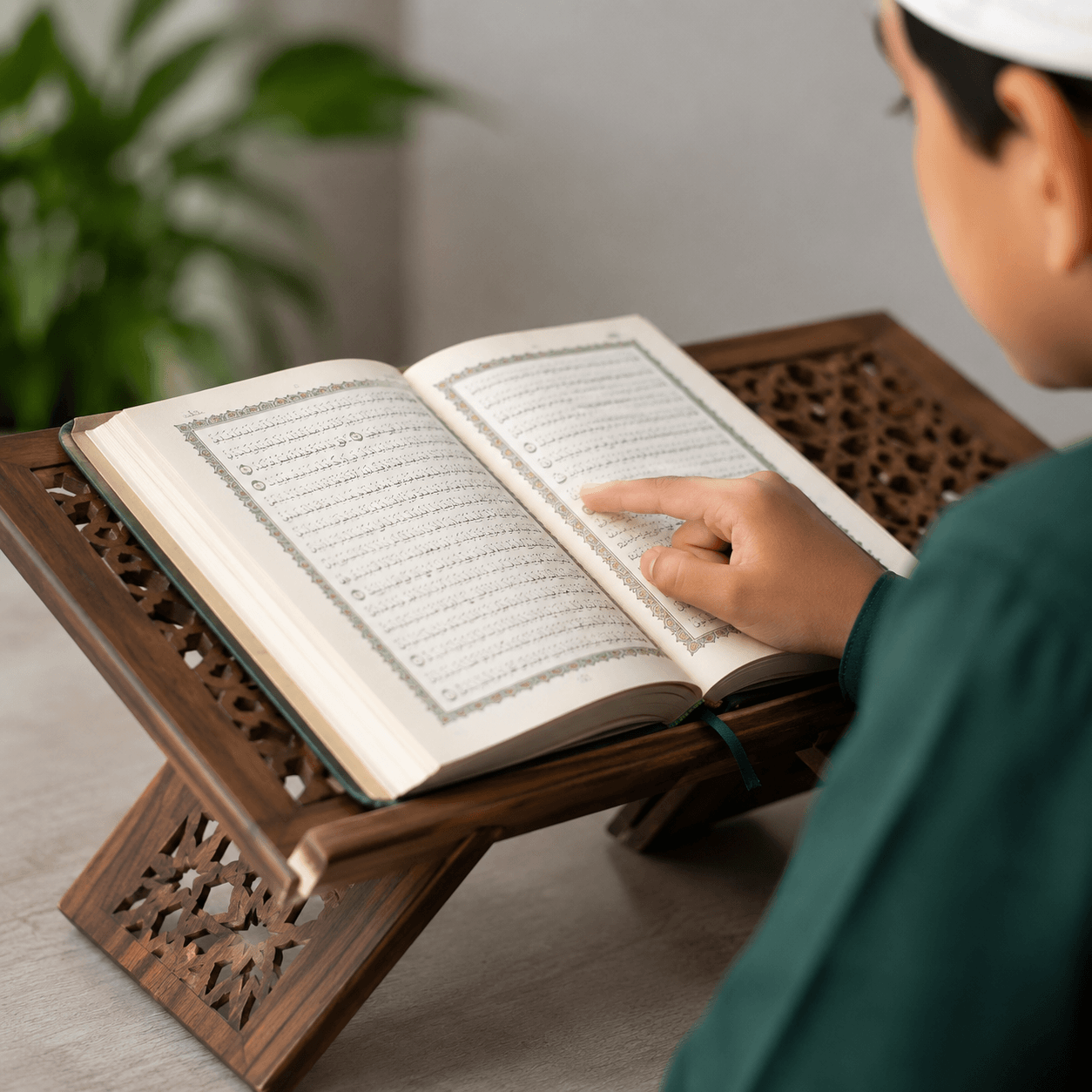
Building Unshakeable Quranic Reading Fluency from Scratch
Quran reading is the essential foundational skill upon which all other Quranic sciences are built. A student who struggles to recognize letter connections or hesitates over vowel marks will find Tajweed frustrating and memorization nearly impossible. Fluent reading requires training the eyes to recognize Arabic letter forms instantly, training the vocal muscles to articulate consonants crisply, and developing the rhythmic breathing necessary for smooth recitation.
Our Quran Reading course takes absolute beginners—both children and adults—through a systematic, phonetically engineered progression that transforms unfamiliar Arabic script into natural, effortless reading fluency.
The Step-by-Step Mechanics of the Noorani Qaida Curriculum
Our reading foundation uses the renowned Noorani Qaida primer, organized into sequential cognitive modules:
• Module 1: The 28 Alphabet Consonants: Distinguishing single letters in isolation, understanding letter names vs. letter sounds, and identifying unique dot placements. • Module 2: Connected Forms: Learning how letters alter their visual contours in initial, medial, and final positions within words. • Module 3: Short Vowels (Harakat): Rapid recognition of Fatha (a), Kasra (i), and Dammah (u) without improper elongation. • Module 4: Tanween & Sukoon: Mastering nunation (double vowels) and consonant resting stops (Sukoon) that form the building blocks of Arabic syllables. • Module 5: Madd Letters & Shaddah: Reading natural two-count vowel stretches and doubled consonants with rhythmic precision. • Module 6: Applied Word Drills: Synthesizing composite Quranic words directly extracted from short Surahs of the Holy Quran.
Overcoming the Five Most Common Beginner Reading Mistakes
Experienced Quran educators frequently encounter five predictable stumbling blocks among beginner readers:
1. Vowel Stretching (Mat't): Accidentally turning short vowels into long vowels (e.g., elongating a Fatha into an Alif). 2. Letter Confusion: Mixing up visually similar letters distinguished only by dot count, such as Baa (ب), Taa (ت), Thaa (ث), and Noon (ن). 3. Breath Starvation: Failing to take adequate breath before long words, resulting in halting, choppy reading. 4. Rushing Over Sukoon: Omitting consonant pauses, which alters word meaning. 5. Over-Emphasis: Applying excessive muscular tension to throat letters rather than producing relaxed, natural acoustic resonance.
Our instructors gently isolate and resolve each tendency through targeted live repetition and audio modeling.
Smooth Transition from Training Primer to the Sacred Mushaf
The transition from the Noorani Qaida to the Holy Quran is a moment of immense spiritual joy. We initiate this transition gradually, starting with the short, rhythmically repetitive Surahs of Juz Amma (such as Surah Al-Ikhlas, Al-Falaq, and An-Nas).
Tutors guide students through line-by-line reading, applying their phonetic training directly to the sacred text until independent reading becomes second nature.
Practical Daily Reading Exercises to Accelerate Fluency
Developing automaticity in Arabic reading requires deliberate, focused practice. We encourage students to spend five minutes daily on single-letter speed drills using flashcards, followed by five minutes of reading two-letter and three-letter word combinations aloud.
Recording your reading on a phone and listening back while following along with the text helps you identify hesitation patterns, inconsistent vowel lengths, and missed Sukoons. When paired with live weekly instruction, these simple home routines cut the time needed to achieve fluent reading in half.