The Challenge and Sacred Privilege of Home Quran Instruction
Teaching children the Holy Quran at home is one of the most rewarding and impactful endeavors a Muslim parent can undertake. Yet, it frequently becomes a source of daily household tension. Parents find themselves caught between wanting their children to excel and dealing with procrastination, short attention spans, and emotional resistance.
The secret to successful home Quran education lies not in longer study hours or stricter discipline, but in understanding early childhood psychology, creating positive emotional associations with the text, and structuring learning into manageable, engaging micro-habits.
Step 1: Shift from Fear and Pressure to Sunnah-Based Encouragement
The Prophet Muhammad (peace be upon him) was described as the gentlest of teachers. He never used harshness, scolding, or humiliation to impart sacred knowledge. When children associate the Quran with raised voices, disappointment, or punishment, they develop an internal emotional defense mechanism that leads to lifelong resistance.
Replace critique with specific, targeted praise: instead of saying "You made three mistakes on that line," say "I loved how clearly you pronounced the letter Qaf on that word! Let's polish this next sound together." Sincere warmth and celebration of small efforts ignite intrinsic motivation.
Step 2: The Power of the 15-Minute Daily Habit-Stack
A common parental error is attempting 45-to-60-minute weekend study marathons to make up for missed weekday practice. Children's working memory and focused attention decay rapidly after twenty minutes. Fifteen focused, joyful minutes practiced five days a week produces vastly superior retention, vocal muscle coordination, and emotional peace compared to weekend cramming.
Use the habit-stacking method: attach the 15-minute Quran block to an already established daily anchor—such as immediately following Maghrib prayer or right before the bedtime story routine.
Step 3: Creating an Inspiring Physical and Sensory Learning Space
Children are profoundly influenced by their physical environment. Designate a specific, quiet corner of the home as the family "Sacred Study Nook." Keep it well-lit, comfortable, and strictly free from distracting screens, tablets, and sibling noise.
Have a special Mushaf stand (Rihal), colorful bookmark ribbons, and a visible sticker milestone chart where the child places a gold star for each completed page. Tangible visual progress creates immense pride and anticipation.
Step 4: Incorporating Multi-Sensory Phonics and Games
Transform repetitive reading drills into multi-sensory activities:
• Kinesthetic Tracing: Have young children trace letter contours in kinetic sand or on a textured tablet. • Melodic Rhythm Clapping: Clap hands rhythmically to demonstrate natural two-count vowel elongations (Madd) versus single short vowels. • The Detective Game: Ask the child to "hunt" for all instances of the letter Noon or Tanween on a given Mushaf page, turning phonetic recognition into a joyful puzzle. • Prophetic Story Rewards: Conclude each reading session with a five-minute story from the lives of the Prophets or animals mentioned in the Quran.
Step 5: When to Supplement Home Study with Professional 1-on-1 Tutoring
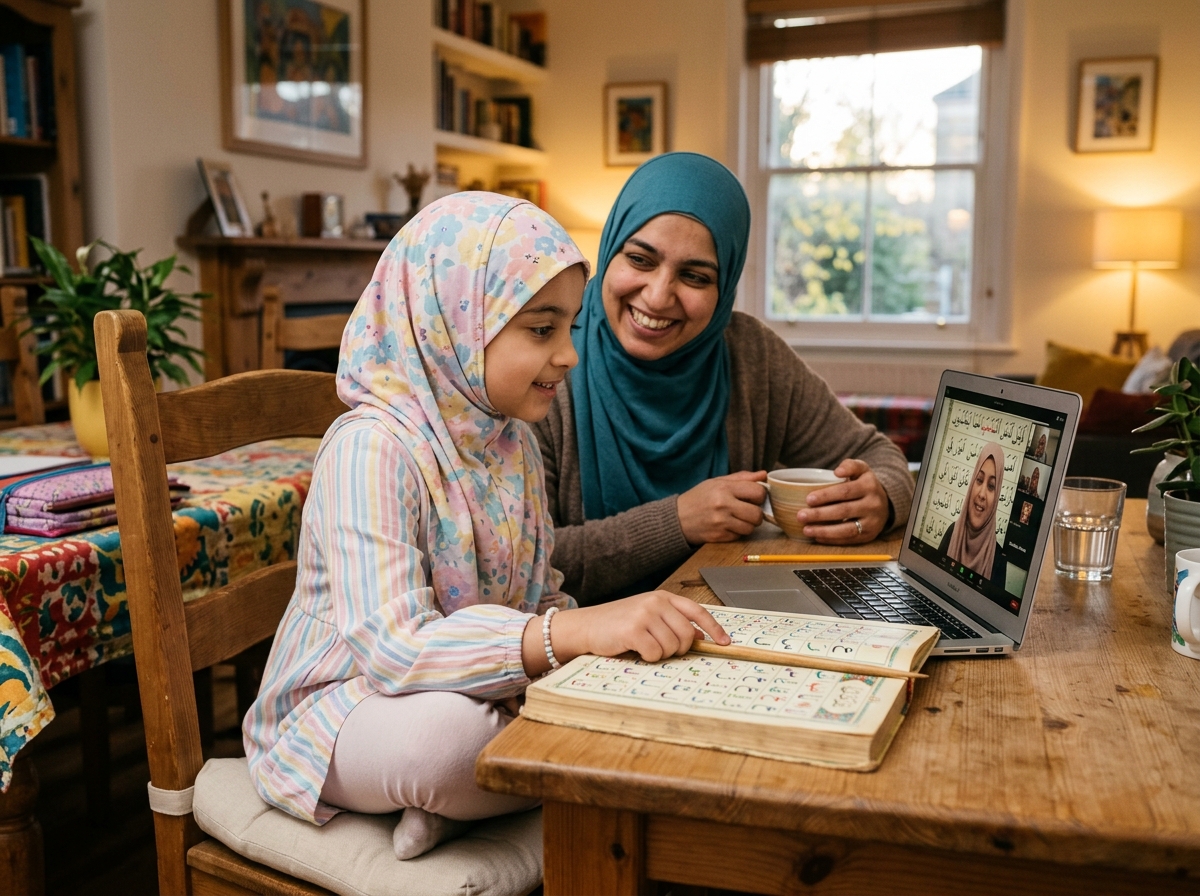
While parental encouragement is vital, teaching correct Tajweed articulation—especially throat letters and elongation rules—often benefits from specialized professional mentorship. A qualified outside instructor removes emotional parent-child friction, establishes healthy accountability, and provides authentic acoustic modeling.
Many families find that pairing live weekly online tutoring with short daily parent-supported review creates the ultimate recipe for lifelong Quranic fluency and spiritual love.
The Art of Encouraging Without Overwhelming: Setting Realistic Milestones
A common misstep in home Quran education is imposing adult expectations on young developing minds. When parents expect a child to memorize a full page or master complex Tajweed rules in a single sitting, frustration inevitably follows.
Effective home pedagogy breaks learning into tiny, celebrated micro-milestones: mastering the recognition of three difficult letter shapes in one week, reading a single verse fluently without stopping, or memorizing two lines of a short Surah. When milestones are achievable, children experience frequent dopamine-driven feelings of accomplishment, fueling their intrinsic desire to practice independently.
A Parent’s Guide to Sustaining Motivation Over the Long Haul
Every family encounters periods where a child’s enthusiasm wanes—often during busy school exam periods or after school breaks. During these plateaus, avoid reacting with anger or punishment. Instead, temporarily scale back lesson length to five low-pressure minutes, focus on listening to beautiful audio recitations during family car rides, and discuss the real-world moral stories of the Prophets.
Remind your child of their previous accomplishments by reviewing earlier completed pages in their Qaida, reinforcing how much they have already grown.
Practical Home Practice Checklist for Parents
Keep daily practice effortless: 1) Practice 10 minutes right after Maghrib prayer. 2) Keep the study desk well-lit and quiet. 3) Play tutor voice notes to mirror pronunciation. 4) Celebrate completed Surahs with family congratulations.